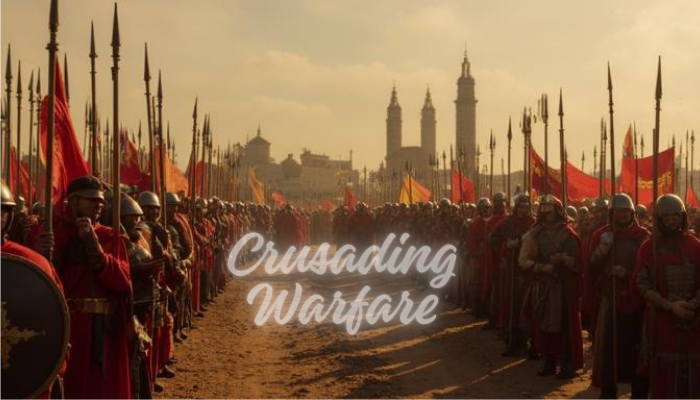
Crusading warfare: more than knights, crosses, and clashes
When most people picture crusading warfare, they imagine armored knights thundering across a sunlit plain, banners snapping, a sacred city somewhere on the horizon. That image is not wrong, but it is incomplete. Crusading war was as much about ships, money, contracts, diplomacy, hunger, and disease as it was about heroics and steel. It was fought in blistering heat and winter mud, in deserts and forests, at city walls and mountain passes. It involved Latin Christians, Byzantines, Muslims from several dynasties, Jews, and a wide array of local communities with their own stakes in survival.
From the late eleventh century through the late Middle Ages, crusading created a distinctive military culture shaped by a powerful religious idea: war could be spiritually meritorious if waged under the right authority and for the right purpose. That claim changed how armies were raised, how campaigns were financed, and how violence was explained to participants. Yet crusading was never purely ideological. It sat at the intersection of faith and pragmatism, where sacred vows met hard questions like, “How do we feed an army for six months?” and “How do we take a fortified port city without a fleet?”
This article explores crusading warfare as it actually worked: its origins, recruitment, logistics, tactics, siegecraft, naval power, and long legacy across Europe and the Mediterranean.
Origins: The idea of a holy campaign becomes a military reality
Crusading warfare grew from older Christian traditions of pilgrimage, penance, and just war. It crystallized at the end of the eleventh century when the papacy offered a striking bargain: take up arms for a sacred cause and receive spiritual benefits, most famously the remission of penance for sins.
The preaching associated with Pope Urban II and the First Crusade (1096 to 1099) provided a framework that combined:
- Religious authorization (papal approval and preaching)
- A vow (to go, to serve, and often to reach Jerusalem or another assigned goal)
- A visible sign (the cross worn on clothing, which also created social accountability)
- A spiritual reward (often described as an indulgence)
The novelty was not that Christians fought. It was the tight coupling of vow, penitential spirituality, and armed expedition, presented as a path of devotion.
From that moment on, crusading warfare became adaptable. It could be directed toward the Holy Land, Iberia, the Baltic, southern France, or even political enemies within Christendom, depending on papal policy and local agendas. That flexibility is one reason crusading lasted so long.
Who fought, and why: vows, ambition, and community pressure
Crusade armies were not uniform national forces. They were coalitions of lords and followers, linked by family ties, feudal obligation, contracts, and personal devotion.
Motivations were layered, not singular.
Many crusaders were genuinely moved by religious conviction. They worried about salvation, hoped to atone for violence, or believed they were defending fellow Christians. Others sought prestige, adventure, land, or a chance to reshape their standing at home. For younger sons with limited inheritance, crusading could look like an opportunity, even if success was far from guaranteed.
Community pressure also mattered. Preachers and local elites framed crusading participation as honorable, sometimes as expected. Taking the cross could transform one’s reputation, at least at the start of the journey. But the same visibility could become a burden if a crusader returned early or failed publicly.
Not only knights
While cavalry nobles dominate popular memory, crusade forces included:
- Foot soldiers and spearmen
- Archers and crossbowmen
- Engineers and craftsmen
- Clergy and administrators
- Servants, drivers, and camp followers
- Merchants and sailors, especially in later crusades
Crusading warfare was a whole expeditionary system, not just a battlefield event.
Financing and supply: the hidden engine of crusading war
A crusade was expensive. Horses, armor, food, transport, and cash for markets along the way could ruin a small lord. Even major nobles struggled.
Crusaders funded campaigns through a mix of:
- Selling or mortgaging land
- Loans from monasteries, towns, or moneylenders
- Contributions from kin networks
- Royal taxation in organized crusades (especially later)
If there is one lesson that repeats across crusade history, it is that logistics shaped outcomes. Armies that could not secure food and water disintegrated. Those that could, often through coastal supply and naval support, had a fighting chance.
In the eastern Mediterranean, supply lines depended heavily on ports. Control of coastal cities meant access to grain, reinforcements, and ships. That is why places like Acre mattered not just politically, but operationally.
Getting there: routes, marching, and the problem of distance.
Crusading warfare was expeditionary. Even before the first spear was leveled, armies faced months of travel. Two broad routes dominated:
- Overland through the Balkans and Anatolia, often involving negotiations with Byzantium and a dangerous passage through contested territory.
- By sea, it became increasingly common as Italian maritime cities developed capacity and as crusaders learned the value of arriving with supplies intact.
The march itself was a form of warfare. Armies had to maintain cohesion, forage without provoking endless local resistance, and manage morale amid hunger and disease. Desertion was a constant threat. So was internal conflict among leaders who were equals rather than a single chain of command.
Battlefield tactics: shock, arrows, and disciplined formations
In the Levant, crusaders met opponents with different tactical strengths, particularly high-mobility cavalry and horse archers. That clash pushed Latin forces to adapt.
Cavalry and the charge
Heavy cavalry remained important. A well-timed knightly charge could break formations, especially when supported by infantry. But it was not a magic solution. Charges required suitable terrain, rested horses, and coordination.
Infantry mattered more than the stories admit
Crusader armies often relied on infantry to hold ground, protect camps, and secure siege operations. In pitched battles, disciplined infantry could anchor a line while cavalry struck at critical moments.
The arrow problem
Turkish and other mounted archers could harass, disrupt, and exhaust. Crusaders responded with tighter formations, protective screens, and an emphasis on maintaining cohesion rather than chasing skirmishers. Commanders learned that patience could be a weapon.
The Third Crusade offers a famous example. At Arsuf (1191), Richard I’s army maintained formation under pressure before launching a controlled counterattack. The details are debated, but the broader point stands: discipline and timing mattered as much as bravery.
Siege warfare: where crusades were usually won or lost
If pitched battles are the most cinematic moments, sieges were the decisive reality. The eastern Mediterranean was a landscape of fortified cities and castles. To control territory, crusaders had to take walls.
Tools and methods
Crusaders and their opponents used:
- Ladders and assault towers
- Battering rams
- Mining and countermining
- Stone-throwing engines such as mangonels and trebuchets
- Blockades to starve cities into surrender
Siege warfare demanded engineers, carpenters, rope makers, and a steady supply. It also demanded time, which invited disease and political fracture in the besieging camp.
Jerusalem, Antioch, Acre: sieges as turning points
- Jerusalem (1099) ended the First Crusade with a successful assault after intense hardship. The aftermath remains infamous for violence.
- Antioch (1097 to 1098) showed how starvation, betrayal, and internal fear could define a campaign as much as combat.
- Acre (1189 to 1191, and again 1291) highlighted the strategic centrality of ports and the brutal endurance contests that sieges became.
In crusading warfare, taking a city was rarely a clean triumph. It was often a grinding calculation of food, morale, engineering, and diplomacy.
Castles, garrisons, and the day-to-day war in Outremer
After the early conquests, crusading warfare shifted from expeditionary invasions to frontier defense. The Crusader States (often called Outremer) relied on fortifications, alliances, and mobile response forces.
Castles served as:
- Observation and signaling hubs
- Safe storage for supplies
- Bases for patrols and raids
- Deterrents that forced enemies into costly sieges
Garrison life was its own world: limited workforce, tense truces, and constant readiness. Warfare included livestock raids, punitive expeditions, escorting pilgrims, and guarding roads. The drama was not always a climactic battle. Often, it was a contest of endurance and local intelligence.
The military orders: professionalization and institutional warfare
No institution symbolizes crusading warfare more than the military orders, especially the Templars and Hospitallers, later joined by others like the Teutonic Knights.
These orders mattered because they offered something rare in medieval warfare:
- Permanent organization
- Fortified infrastructure
- Experienced fighters who remained in the theater
- Administrative capacity to move money and supplies across regions
They were not invincible or politically uncontroversial, but they provided continuity between crusade waves. In practical terms, they helped turn crusading from a series of one-off expeditions into a long military presence.
Naval warfare and maritime power: the sea as a crusading highway
As crusading matured, the sea became central. Italian city-states, especially Venice, Genoa, and Pisa, brought ships, sailors, and commercial networks. Transport by sea reduced attrition and improved supply reliability.
Naval power enabled:
- Amphibious landings
- Coastal resupply of armies
- Blockades of ports
- Rapid reinforcement of threatened cities
The maritime dimension also reshaped crusading goals. Controlling port cities became synonymous with controlling the war’s lifelines. It is difficult to overstate how often crusading success depended on ships rather than swords.
Crusading beyond the Holy Land: Iberia, the Baltic, and internal crusades
Crusading warfare was never confined to Jerusalem.
Iberian Crusades and the Reconquista
Campaigns in Spain and Portugal blended local territorial ambitions with crusade preaching and papal privileges. Warfare there included sieges of major cities, frontier raiding, and the slow consolidation of zones of control. The presence of strong Muslim states meant the military balance shifted over centuries rather than in a single decisive event.
Baltic crusades
In the north and east, crusading targeted pagan societies around the Baltic. The environment produced a different style of warfare: forests, rivers, and winter campaigning. Fort-building and seasonal raids were common, and the Teutonic Order developed a state-like military machine.
Crusades within Christendom
The Albigensian Crusade against Cathar heresy in southern France shows the elasticity and danger of crusading ideology when turned inward. Warfare here looked like feudal conflict intensified by religious authorization, with sieges, massacres, and long political consequences.
These theaters remind us that “crusading” described a legal and spiritual framework as much as a single geography.
Adaptation and exchange: technology, tactics, and cultural contact
Crusading warfare produced constant contact between military cultures. That contact involved fear and demonization, but also learning.
Crusaders encountered sophisticated fortification traditions, refined siege methods, and different approaches to cavalry and archery. They adjusted equipment for climate and campaign needs. Meanwhile, Muslim powers responded to Frankish castles and heavy cavalry by strengthening coordination, improving siege capacity, and consolidating political authority when possible.
It is tempting to describe this as a simple story of European “progress,” but reality was reciprocal. The Mediterranean was a zone of exchange. War accelerated that exchange, even while it inflicted terrible losses.
Rules, restraint, and brutality: the moral tensions of holy war
Crusading warfare sat uneasily beside Christian moral teaching. Preachers framed crusading violence as justified, even meritorious, but the practice of war regularly fell short of those ideals.
Ransoming prisoners was common, but so were massacres, especially during assaults when command and control collapsed. Civilians suffered through starvation in sieges, displacement, and economic ruin. Jewish communities in Europe faced catastrophic violence during some crusading movements, a grim reminder that zeal often sought nearby targets.
At the same time, crusade leaders made truces, exchanged gifts, negotiated prisoner swaps, and engaged in diplomacy that looked surprisingly pragmatic. Holy war rhetoric did not eliminate political realism. It lived alongside it, sometimes in the same person.
The long legacy: how crusading warfare shaped medieval Europe
Crusading warfare left enduring marks:
- Military organization: greater reliance on contracts, cash, and planning for distant campaigns.
- Fortification and siegecraft: sustained emphasis on engineers, artillery, and defensive architecture.
- Maritime strategy: rising importance of fleets and port control in European warfare.
- Political authority: expanded papal influence in mobilizing war, alongside growing royal capacity to tax and organize large expeditions.
- Cultural memory: crusades became symbols used for later agendas, sometimes romanticized, sometimes weaponized.
The crusades did not create European warfare from scratch, but they sharpened its tools and broadened its horizons. They also left a legacy of contested memory that still shapes how societies talk about religion and violence.
Conclusion: understanding crusading warfare in full
To understand crusading warfare is to look past the postcard image of knights at full gallop. Crusading was an entire system: a spiritual promise, a legal status, a fundraising campaign, a logistical feat, a maritime enterprise, and often a siege operation that tested human endurance.
It was also an arena where ideals collided with consequences. Participants could believe sincerely that they served God, even as their actions brought suffering to innocents. Leaders could speak in sacred terms while negotiating like hard-headed politicians. Crusading warfare was medieval life at its most intense, with all the contradictions that imply.
Seen clearly, the crusades are neither a simple tale of glory nor a single story of villainy. They are a complex history of how people, convinced that heaven had endorsed their cause, tried to solve worldly problems through organized violence, thereby changing the medieval world.